
Construction & Industrial HSE Regulatory Framework (EPC-Level Analysis)
A practical, contractor-facing breakdown of how UAE HSE compliance actually works in construction and industrial execution. This page explains the layered regulatory system, what inspectors focus on in the field, what documentation is expected on EPC projects, and where contractors commonly fail during implementation.
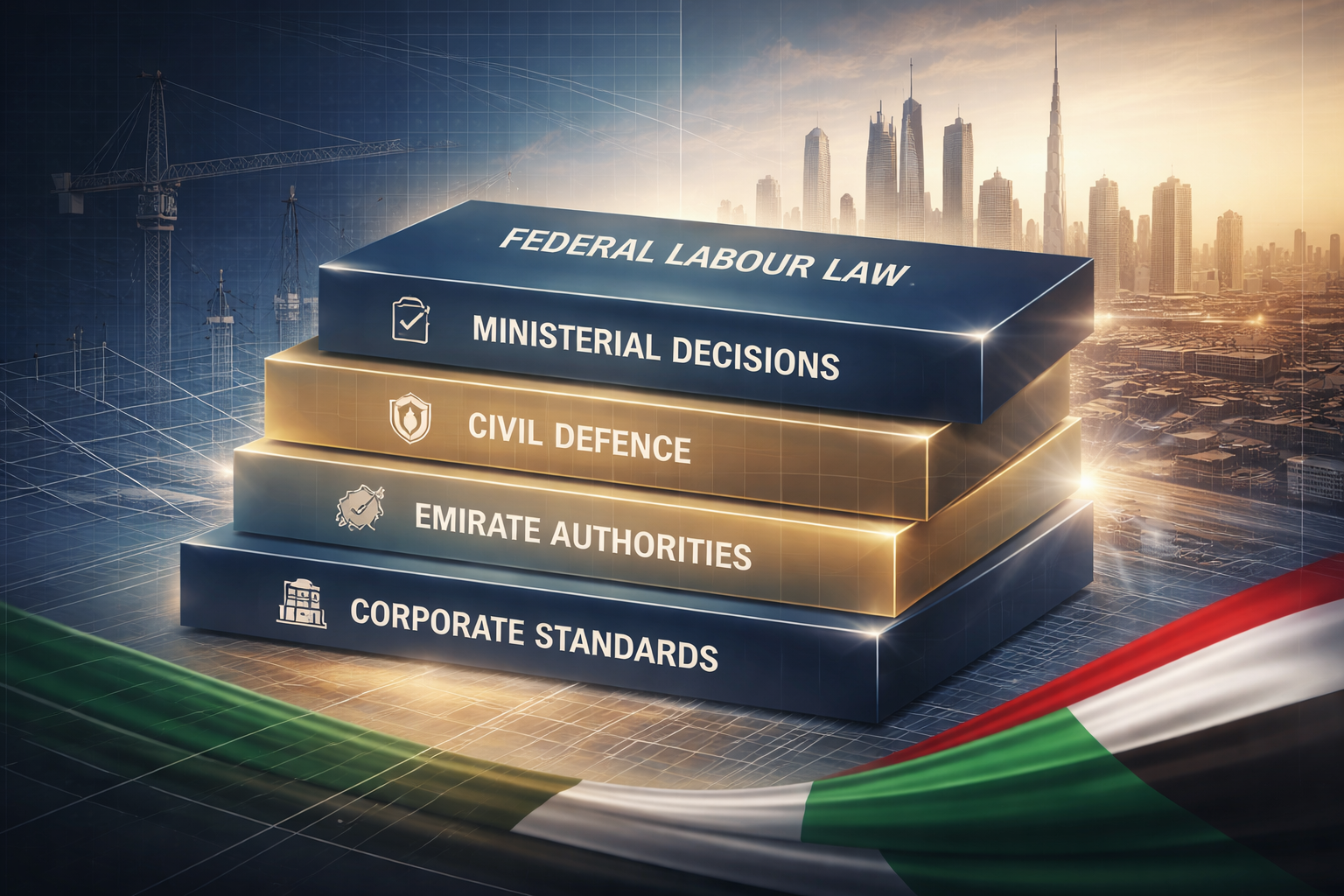
1. Regulatory Architecture in the UAE — How It Actually Works
Occupational health and safety in the UAE does not operate under a single “OSH Act” in the way some Western jurisdictions do. Instead, it is structured through federal labour legislation, executive OSH regulations, Emirate-level municipal enforcement, Civil Defence fire and life safety requirements, and project-owner overlays across EPC, oil and gas, and utility projects.
Understanding this layered system is critical for contractors because compliance obligations are distributed across multiple authorities and enforcement expectations often depend on the project type, site risks, and the Emirate in which execution is taking place.
1.1 Federal Baseline Obligations
The primary federal instrument governing workplace safety is:
Federal Decree-Law No. 33 of 2021
Relevant safety obligations are embedded primarily within:
- Article 13 – Employer duties
- Article 36 – Worker protection requirements
- Article 37 – Occupational injury reporting
This law establishes the baseline duty of care: employers must protect workers from hazards and provide appropriate preventive measures. However, the Labour Law sets the obligation framework, not the detailed technical construction standards used on site.
1.2 Executive OSH Requirements
Cabinet Resolution No. 37 of 2016 expands employer safety responsibilities and is highly relevant for EPC contractors building defensible HSE systems.
It requires, among other controls:
- Hazard identification and risk assessment
- Preventive control implementation
- PPE provision
- Emergency preparedness
- Worker training
From an EPC perspective, this is where the documented HSE Plan becomes legally and operationally defensible, provided it is project-specific and implemented in the field.
1.3 Fire & Life Safety Overlay
Construction and industrial projects must comply with the UAE Fire and Life Safety Code of Practice.
Enforcement is typically handled by Emirate Civil Defence authorities, including:
- Dubai Civil Defence
- Abu Dhabi Civil Defence
- Other Emirate Civil Defence authorities
In practice, Civil Defence compliance often becomes the most visible enforcement trigger on projects involving high-rise construction, warehouses, industrial facilities, labour accommodations, and complex fire/life safety interfaces.
Fire system approvals, emergency access, evacuation planning, and hot work segregation are routinely inspected and can materially affect project progress.
2. What UAE Authorities Actually Look For on Construction Sites
Across GCC project environments, UAE inspections frequently focus on visible execution risks and supervisory control quality rather than paperwork volume alone. Documentation matters, but inspectors typically validate whether site conditions match the controls stated in the documents.
2.1 Working at Height
Inspectors frequently examine:
- Scaffold tagging
- Guardrail completeness
- Harness anchorage integrity
- Edge protection
- Ladder condition
A risk assessment that only states “fall hazard” without specifying anchorage type, inspection regime, access sequencing, or supervision controls is often viewed as superficial.
2.2 Lifting Operations
Authorities typically expect:
- Engineer-approved lifting plan
- Load calculation verification
- Crane certification
- Operator and rigger competency cards
- Exclusion zone enforcement
A generic lifting method statement without load charts, lifting studies, or rigging sketches is commonly rejected during EPC audits and internal client assurance reviews.
2.3 Excavation Controls
Excavation enforcement commonly checks:
- Shoring or benching arrangements
- Utility detection evidence
- Excavation permit validity
- Barricading and exclusion control
- Access and egress arrangements
Failure to demonstrate underground service verification is a common shutdown trigger and remains one of the most expensive preventable gaps on utility corridor work.
2.4 Heat Stress (Summer Enforcement)
During UAE summer midday ban periods, authorities may verify:
- Break schedule adherence
- Shaded rest areas
- Water availability
- Heat stress monitoring and supervision
Failure to comply during restricted hours can result in immediate penalties and site action, especially where worker welfare provisions are visibly inadequate.
3. Documentation Expectations in UAE EPC Projects
In practical terms, UAE compliance is often documentation-light but implementation-heavy. Authorities and client-side auditors typically expect a project-specific control system that reflects actual site conditions and current execution phases.
Project-Level Documentation
- Project-specific HSE Plan (not template copy)
- Emergency Response Plan
- Risk Register
- Environmental controls
- Welfare provisions
Activity-Level Documentation
- Task-specific Risk Assessment
- Method Statement aligned with the risk assessment
- Permit to Work for high-risk activities
- Lifting Plan (engineer reviewed)
- Confined Space Permit
- Hot Work Permit
“Does this document reflect what is actually happening on site today?” is often the most important audit question.
4. Where Contractors Commonly Fail
Repeated non-conformities observed across UAE projects often include:
- Copy-paste risk assessments reused from previous projects
- Method statements that do not match the current phase of work
- PTW systems implemented on paper but not actively monitored
- Emergency drills conducted without realistic scenarios
- Subcontractor documentation not integrated into main contractor control
- No traceable corrective action tracking
The recurring problem is rarely the absence of documentation. The problem is weak alignment between documentation and execution control.
5. Enforcement Consequences
UAE authorities have broad discretionary enforcement powers, especially where there is visible risk exposure, repeated non-conformance, or serious incident potential.
Consequences may include:
- Administrative fines
- Temporary site closure
- Stop-work notices
- Contractor blacklisting
- Referral for criminal investigation in severe negligence cases
Major incidents may trigger multi-agency investigations involving labour authorities, Civil Defence, and municipal departments depending on project scope and incident severity.
6. Strategic Compliance Insight for EPC Contractors
The UAE regulatory system tends to reward:
- Structured documentation
- Activity-specific risk logic
- Visible supervisory control
- Traceable corrective actions
- Proper coordination between trades
It tends to penalize:
- Template repetition
- Paper-only compliance
- Weak subcontractor governance
- Permit systems that exist only in theory
For contractors operating in multi-trade, high-rise, or oil and gas environments, structured and activity-driven compliance systems are not optional; they are operational survival tools.
Apply This Framework in AskHSE
Use AskHSE to generate project-specific HSE plans, risk assessments, method statements, and permit controls aligned to UAE/GCC execution realities.
UAE HSE Compliance FAQs
What legislation governs construction safety in the UAE?
Construction safety in the UAE is governed by Federal Decree-Law No. 33 of 2021, Cabinet Resolution No. 37 of 2016, and the UAE Fire and Life Safety Code of Practice, with enforcement at Emirate level.
What documents are typically required for UAE construction compliance?
Authorities typically expect a project-specific HSE Plan, task-specific risk assessments, method statements aligned with execution, lifting plans for crane operations, permit-to-work systems, and emergency response documentation.
References
- Federal Decree-Law No. 33 of 2021
- Cabinet Resolution No. 37 of 2016
- UAE Fire and Life Safety Code of Practice
- Ministry of Human Resources and Emiratisation – https://www.mohre.gov.ae
- Dubai Civil Defence – https://www.dcd.gov.ae