
Why Risk Assessments Fail on GCC Construction Sites
A Field-Based, No-Nonsense Analysis for EPC Projects
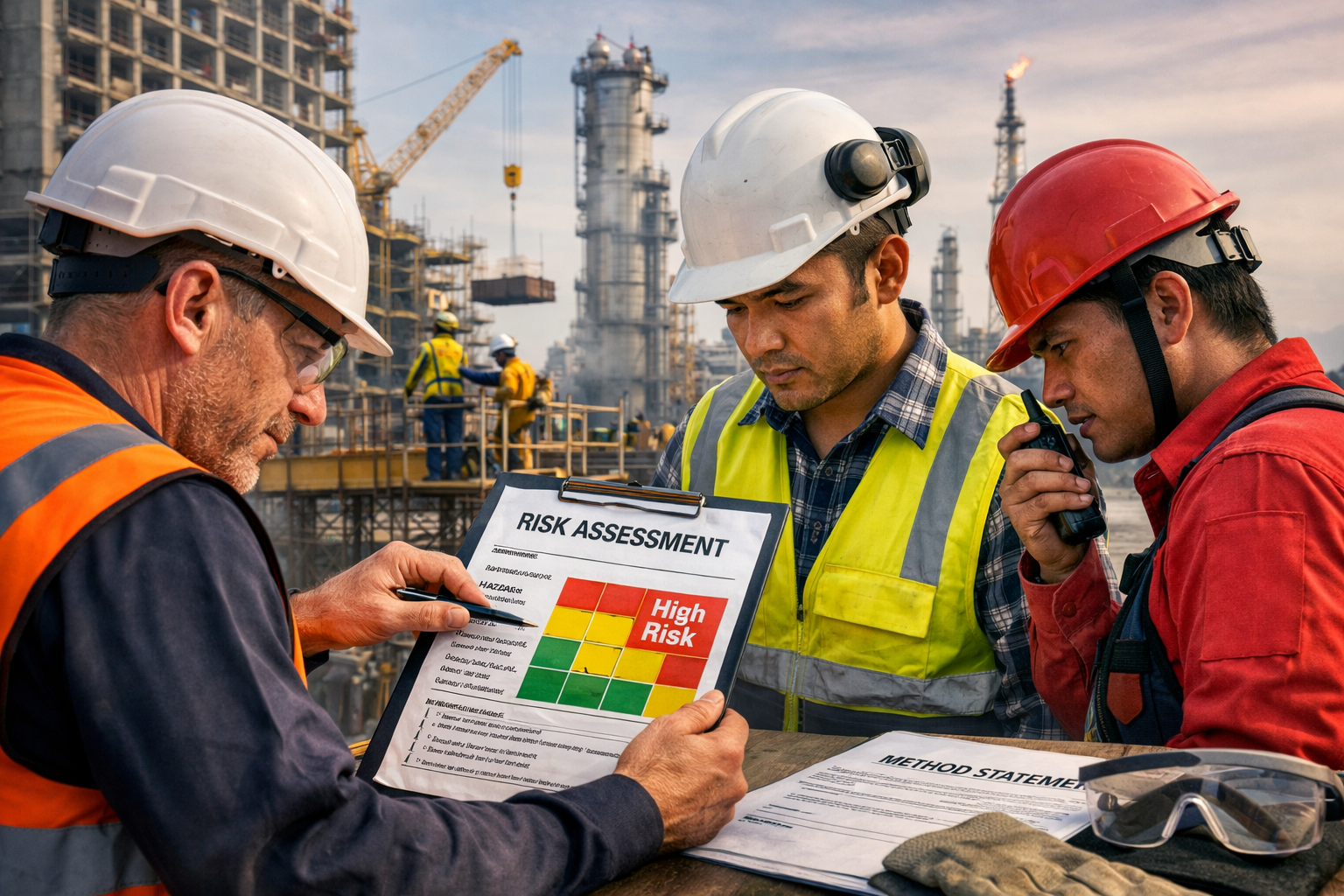
Introduction — The Problem Nobody Admits
Every GCC construction site has risk assessments.
Every contractor says they are “in place.”
Yet during inspections, audits, or post-incident investigations, those same documents are exposed as weak, generic, or disconnected from reality.
The problem is not the absence of paperwork.
The problem is that most risk assessments in the Gulf are written for compliance optics — not execution control.
This article breaks down, practically and honestly:
- Why generic risk assessments fail audits
- How copy-paste culture destroys credibility
- Why RA and Method Statement misalignment creates real risk
- How PTW systems collapse without RA integration
- The misuse of residual risk scoring
- What inspectors actually ask on site
- How to build defensible, execution-driven risk assessments
1️⃣ Why Generic Risk Assessments Fail Audits
The most common audit failure across GCC projects is this:
A risk assessment exists — but it is not specific.
It contains:
- “Fall hazard”
- “Struck by object”
- “Manual handling injury”
- “Electrical shock”
But it does not answer:
- From what height?
- Which edge?
- What anchor system?
- What isolation method?
- Which lifting configuration?
- Which exclusion zone dimension?
Inspectors and client HSE managers don’t care about hazard lists. They care about control specificity.
If your RA cannot clearly demonstrate:
- Where the risk is,
- How it is controlled,
- Who is responsible,
- And how it is verified,
It fails credibility.
2️⃣ The Copy-Paste Culture in EPC Projects
Let’s be honest.
Many EPC companies reuse risk assessments across:
- Different projects
- Different phases
- Different contractors
- Different countries
The layout stays the same. The wording barely changes.
What changes? Only the project name in the header.
This creates three major risks:
1. Controls not matching real execution
A scaffold risk assessment reused for a different elevation condition may ignore:
- Façade interface
- Overhead lifting
- Wind exposure
2. Residual risk artificially reduced
Often the residual risk score is automatically dropped to “Low” because “PPE provided.”
Without verification logic.
3. Legal exposure
If an incident occurs and the RA clearly does not reflect site conditions, it becomes evidence of negligence.
In GCC jurisdictions, this can escalate quickly.
3️⃣ The Disconnect Between Risk Assessment and Method Statement
On many projects, RA and MS are written separately.
The RA identifies hazards. The Method Statement describes the work process.
But they do not reference each other.
For example:
RA says:
Control: “Use mechanical lifting aids.”
Method Statement says:
“Materials will be lifted manually to level 3.”
That contradiction destroys the integrity of the system.
A defensible RA must:
- Be directly referenced in the Method Statement
- Control the sequence of work
- Align with engineering method
- Reflect actual tools and equipment used
If the RA is not operationally embedded into the MS, it becomes decorative documentation.
4️⃣ Permit to Work Systems Not Aligned to Risk Assessment
This is one of the biggest structural failures.
PTW systems are implemented for:
- Hot work
- Confined space
- Excavation
- Electrical isolation
- Lifting
But often the permit checklist is generic and does not reference the RA controls.
Example:
RA requires:
- Fire watch
- Fire blanket
- Gas testing
- Barricade zone
PTW checklist verifies:
“Hot work permit signed”
That is not control alignment.
A strong compliance system requires:
- RA controls integrated into PTW checklist
- Supervisor confirmation that RA controls are active
- Evidence of monitoring during permit validity
Otherwise, the permit becomes a signature ritual.
5️⃣ The Misuse of Residual Risk
Residual risk scoring is frequently abused.
Common pattern:
Initial Risk = High
Control listed = PPE
Residual Risk = Low
That is mathematically and logically flawed.
Residual risk should reflect:
- Effectiveness of control
- Engineering robustness
- Reliability of supervision
- Human error probability
If your residual risk is always “Low,” inspectors assume the RA is unrealistic.
Real projects still contain Medium risks — even after controls.
Admitting that reality builds credibility.
6️⃣ What Inspectors Actually Ask on Site
During audits or inspections in GCC projects, common questions include:
- “Show me the risk assessment for this activity.”
- “Who briefed this to the workers?”
- “When was it last reviewed?”
- “Where is the lifting study?”
- “What happens if this control fails?”
- “Who is monitoring this exclusion zone?”
They rarely ask:
“Does your template look professional?”
They ask:
“Does this control exist right now?”
If the supervisor cannot answer confidently, the system collapses.
7️⃣ How to Build Defensible Risk Assessments
A defensible RA in GCC construction must be:
- Specific
Location-based
Phase-specific
Trade-specific - Integrated
Referenced inside the Method Statement
Linked to PTW controls
Aligned with lifting plans and engineering calculations - Owned
Assigned responsible person
Signed by supervisor
Briefed through toolbox talks - Verified
Inspection logs linked to RA controls
Photographic evidence where relevant
Corrective actions tracked
Apply this on your site today
If you want a structured, execution-ready risk assessment (not a generic template), use the AskHSE Risk Assessment Generator. It helps you build activity-specific hazards, controls, and residual risk logic in a submission-ready format.
8️⃣ The Executive Perspective — Why This Matters
From a project director’s standpoint, weak risk assessments create:
- Delay risk
- Legal exposure
- Insurance complications
- Reputational damage
- Client trust erosion
Strong risk assessments:
- Reduce shutdown probability
- Improve audit performance
- Protect management in investigations
- Demonstrate operational maturity
Conclusion — Risk Assessments Are Control Tools, Not Documents
In GCC construction environments, risk assessments fail not because they are missing — but because they are misused.
When treated as:
- A compliance checkbox
- A recycled template
- A static document
They collapse under inspection.
When treated as:
- A live execution control system
- An engineering-aligned framework
- A supervisory accountability tool
They become defensible.
And defensibility is what protects projects.